Monday, 24 November 2025

Still not dead...

Nope. Not yet. 

 It snowed the other day, which was nice. Today it's raining, which is not so nice. 


 Here's somebody who was clinging to the front of our house the other day. Also nice. Weirdly torpid, sufficiently to be able to catch it by hand, but it flew off ok into the back garden (swearing as it went) when my daughter released it.


 Clearly (!) different from Short-toed Treecreeper by virtue of the broad pale tips to the primaries, the square-ended pale bars in the primaries and the large pale blob on the largest alula feather. So much easier when they call...

Thursday, 27 April 2017

Migration

April, April, macht was er will is the local saying and the month has certainly lived up to it. Blazing sunshine to begin with, then snow - albeit very temporary - last week. A couple of days of ok weather to start this week, then relentless rain and rather cold temperatures today. Ideal to have a quick nose around the mouth of the Schussen after dropping the girls at kindergarten, particularly as it's the height of migration at present.

The lake shore is rather narrower than over winter as the snow melts off the mountains and fills the lake, so anything feeding on the shore is closer - makes life easier sometimes. The shoreline also has a thriving strandline community, primarily Catabrosa aquatica with lots of Ranunculus scleratus, and a smattering of Cardamine species, Rorippa and tree seedlings. This, and the strandline of decaying leaves of last year, make a good hunting ground for migrant birds, particularly where the shore is backed by woodland.

Sure enough, as I arrive at the lakeside, there is a smart male Whinchat busily diving in and out of the vegetation. A blur of black and white resolves into a male Pied Flycatcher, and the morning feels like it's going to be productive...

By the river mouth the willows are buzzing with Pied Flycatchers and another couple of Whinchat are hopping round the shoreline. A series of shrill 'zeeep's draw attention to a trio of glowing Yellow Wagtails, males a feast of citron, green and powder-blue. More noise from the willows now: a Grasshopper Warbler reeling, a Turtle Dove purring (how long since I last heard that?!), then a Marsh Warbler burbling out a stream of mimicry. A flash of red: a female Common Redstart flirting her tail, and then -almost an afterthought, a pair of Ortolan Buntings hopping quietly around, feeding on seeds of annual ruderals.

After all that, the lake itself is almost a disappointment: just a few hundred swallows skimming the water, a couple of Little Ringed Plover, two Wood Sandpipers and a trio of Greenshank to liven up the standard fare. The rain shows no sign of letting up and my hands are by now somewhat chilly, so heading home seems most sensible, but even that route produces another handful of Pied Flycatchers.

Given the continuing cold and rain, you have to marvel that these birds can make it. Hopefully the forecast improvement in the weekend weather will give them a chance to carry on to wherever they are headed.

Wednesday, 12 April 2017

I'm not dead...

Honest.

Red Kite - common and easy to see here, unlike in Devon. My duaghters can now confidently identify them and pick out the Black Kites when they come by.

Myosotis rehsteineri. A Lake Constance endemic now, apparently extinct at all its former locations in the Alps....

...determinedly a non-competitor, this is a plant of the strandline, flowering twice a year when the water levels permit...

...this is the biggest patch of it that I've yet seen. A low-growing, yet startlingly blue and showy plant...

...and although not good at holding out in the face of competing plants, it has a tough little niche to survive in. More on this plant - and others - later.

Sympecma paedisca - Siberian Winter Damsel. The more eastern of the winter damselflies in Europe and so far the only individual of the species that I've seen.

A spectacular non-native: Giant Knotweed, Fallopia sachalinensis.

Crocus meadow in the Brandnertal, Austrian Alps

Full of Crocus vernus ssp albiflorus and Soldanella alpina. Carex caryophyllea and an Alchemilla in there too for the connoisseurs

Yet another crocus meadow. Bit boring really (not!)

Saturday, 11 February 2017

February sings of spring. Or signs?

February already. Where is the year going? The days are lengthening rapidly and the snow has now melted; just a few dirt-encrusted patches of white here and there in the most shady nooks bears testament to the blanket that covered us in January. When the weather is clear and the mountains are visible, it is possible to chart the gradual upward climb of the snowline, but days with clear skies are rather sparse at the moment: either it is grey and mild, or sunny and hazy. Or it rains.

The most obvious response to the change in temperature and day-length is, of course, from the birds. Suddenly there is song all around - the two-tone repetitive 'tee-tah' of Great Tits the most striking to start with. They were quickly joined by drumming Great Spotted Woodpeckers and the slightly manic laughter of Green Woodpeckers. Listen with more than half an ear and you will hear the similar, yet somewhat more mournful song of Grey-headed Woodpeckers, which seem to be widespread in the local area. Over the last week a Black Woodpecker has added a wild, ringing 'klooouuu' to the mix too.

A swelling chorus of Chaffinches is emerging - for now most of the males rather hesitantly launching their songs, so that they fade out into a jumble of notes soon after starting, but it won't be long before they ring loud in the woods and gardens. Mistle Thrushes and Blackbirds have also begun to polish up their notes for the coming spring. All in all, it won't be long before a proper dawn chorus is waking us each day and the first trans-Saharan migrants will start filtering through on their way north. A smart male Black Redstart feeding at the foot of the Schloss Montfort last week could well have been a bird moving back north from the Mediterranean, as could the little flock of Serins feeding in the asparagus fields on the way down to the kindergarten on Friday.

The ground is still cold though, so the plants are not yet really starting to move: a few fresh-looking leaves of Lesser Celandine and some new shoots of Greater Pond Sedge all the evidence that I can find of new growth just yet. It won't be long, though, before we can start to fossick through the woods and meadows to see what there is to offer here. A promise of warmer weather next week suggests that the local beavers will be starting to get out and about again: perhaps a chance to use the camera trap again for something more exotic (to me) than foxes and Roe Deer!

Though there aren't many juicy plants to be seen at present, there is still colour and interest to be found in bryophytes and fungi in the woods.

A gratuitous patch of Radula complanata

A recent visit to an old stamping ground was productive. The Rheindelta on the southern shore of the Bodensee is a long pair of artificial banks which channel the river Rhine out into the lake for a couple of kilometres. The bay just to the west of the river is one of the larger areas of shallow water in the lake and thus proves attractive to waterfowl. A calm day was impetus enough to go back and explore for the first time in thirteen years (how did that happen?!) and show the children some ducks.

The Fussacher Bucht did not disappoint. The bay was three-quarters frozen, so birds were concentrated near the lagoons and, despite an appalling winter for wildfowl on the lake overall, there were still enough birds to impress two small children. The duck flock was two or three thousand strong, divided equally between Red-crested Pochard, Tufted Duck and Common Pochard, with a smattering of Goldeneye around the fringes. Sprinklings of Coot, Whooper and Mute Swans, Caspian Gulls and Goosander added a little variety to the mix, while a bevy of cold-looking Grey Herons and Great Egrets speckled the banks. A lone fox on the ice caused mild alarm among the ducks for a while, but stood no chance of snaring any but the most dim-witted of them and eventually trotted gently back towards the reed fringe of the Rohrspitz.
Mixed ducks (all the specks at the back) in the Fussacher Bucht - a small group of Red-crested Pochard lurk in the foreground

Saturday, 14 January 2017

The frozen south

The last two months have been rather hectic in all. Having moved, registered and dealt with all the bureaucracy around health-care, car and insurance, we finally found a place to live in Eriskirch. This meant that we had to re-do a chunk of the bureaucracy to keep our adress up-to-date, but that's a small price to pay for a bit of stability.

The new flat is just a couple of minutes' walk from the Eriskircher Ried: our local patch, if you will. [Apologies, but a good few of the links in this post will be in German. Google Translate may help, but don't count on it...] The Ried (map in link) is a fairly large protected area - one of the largest on the German portion of the Bodensee shoreline - and consists of 600 hectares of the lake shore, associated reedswamp and fen, with 'streuwiesen' and woodland further inland before the orchards reappear. 

The protected area is a Natura 2000 site (link to the data forms here: use the bottom three links for the pdfs), an SPA (Special Protection Area designated under the EU Birds Directive for those who may not know) designated in 2007. It appears to be important for populations of various breeding birds: Hobby, Great Reed Warbler, Quail, Grey-headed Woodpecker and Wryneck in particular, and for a sizeable aggregation of wintering waterbirds; counts of about 10,000-20,000 Tufted Duck and Pochard are mentioned, along with around 1,500 Red-crested Pochard. So, in theory, the local patch looks pretty interesting.

In practice, there certainly seems to be plenty of potential. Diving duck are fairly prominent around the lake edge, though Goldeneye and Red-crested Pochard seem to be the most abundant species at present this winter (acknowledged that it's a fairly poor winter for waterbirds so far though). There are also plenty of Mallard, Coot, Great Crested Grebe and Cormorant. There are always groups of Goosander scattered around and Little Grebe are more plentiful than anywhere I have ever been before. Whooper Swans are here in reasonable numbers, along with a small number of Bewick's. Black-headed, Common, Caspian and Yellow-legged Gulls are all widespread (ah, the joys of returning to the complexities of large white-headed gull identification) and herons are represented by lots of Grey Heron and variable numbers of Great Egret. Grey-headed Woodpecker are certainly around, if thinly-spread, though the landbird scene is rather restricted by the time of year and a decent blanket of snow in the last week or so, along with some freezer-like temperatures.

Pictures of the meadows in spring and summer look enticing, so as the year continues to turn, it's going to be an exciting time with plenty to discover. I dare say there will be more on the subject later!

The river at the south of the Ried - the Schussen - at the start of the snowfall. Three days later the river had frozen across, leaving a disconsolate-looking troop of Teal marooned on the ice.

Looking north across the meadows towards Eriskirch, where the church rather dominates the skyline.

A view across the meadows to some mistletoe-infested willows.

Tuesday, 13 December 2016

Numbers, numbers

The Bodensee is pretty big. Being utterly lazy and looking on Wikipedia rather than doing a bit of GIS, the surface area of the lake is about 571 square kilometres. Approximately half the area of Dartmoor for the Devon reference. For someone who grew up thinking that Roadford Lake was pretty big (about 295 hectares), it's an impressive body of water.

I frequently find myself somewhat unsettled on an almost subliminal level to go dwn to the shoreline and discover that the tide has neither risen nor fallen. I'll get used to it. There are tidelines along the shore, a mix of decaying water plants and algae picked over by gulls, crows and Water Pipits, so there is a resemblance to the seashore. The lines mark the various windy periods and floods though, rather than any familiar ebb and flow.

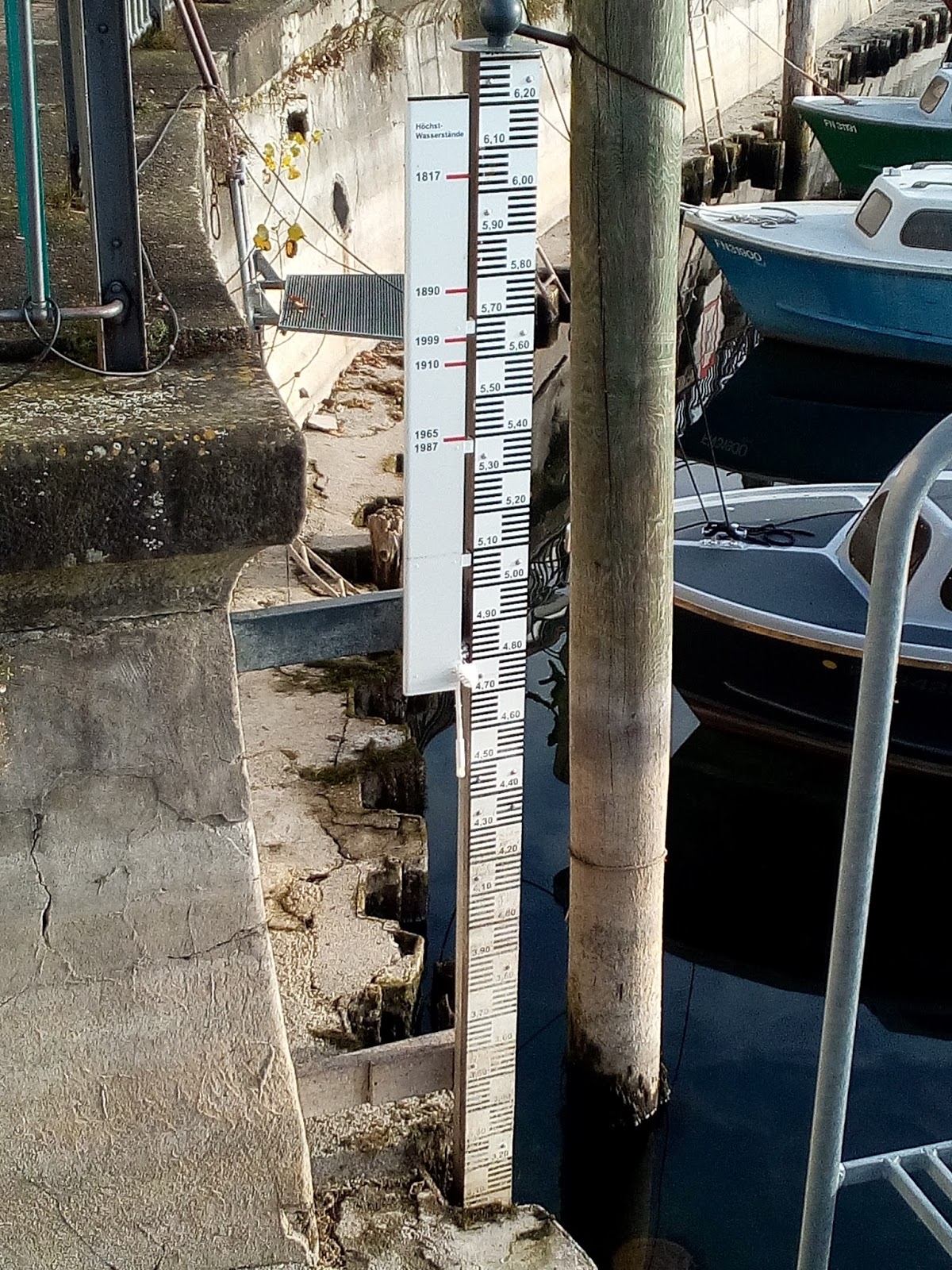
There are water gauges at strategic points around the shore. Langenargen harbour has one which runs from the current level (somewhere over 3 metres) to 7 metres, with the notable floods of the past marked on it near the top. These are impressive enough just to look at as a red line on a board above the current lake level: the highest recorded flood was in 1871, reaching 6.91m - this level also carefully marked on the adjacent tourist information office wall. Then try and grasp the sheer volume of additional water present in the lake to reach that height! Even if you ignore the fact that the lake shore is rather flat and just run a 'cylinder' vertically upwards, trying to fit 3 metres of water onto half of Dartmoor is somewhat hard to comprehend.

Some fag-packet calculations (assuming my arithmetic is robust). When the water level in the lake reached 3m above what it is today, that works out to about 1,713,000,000 cubic metres of water. Some 685,200 Olympic-size swimming pools. Put more simply still, that's an awful lot of water. A;though the whole lake catchment is large, the major input of water to the lake is the Rhine: the river must have been an awe-inspiring sight, particularly at the Rhine Falls just below the lake's exit. At this point the river drops some 20m; spectacular at the quietest of times.

There it is folks, in black and yellow

And just to add weight to the tourist information office walls.

Langenargen harbour this morning.
For a post-script: the lake froze over on a number of occasions, the most recent being in 1963, when at least one brave chap apparently rode a horse across the lake. Given that you're crossing a body of water which reaches some 250m depth... well. Where is the dividing line between bravery and foolhardiness, I wonder? I also wonder what the horse thought about it?

Sunday, 27 November 2016

The Argenmündung (mouth of the river Argen)

The lake and sky both lie grey and still, sound melting into the mist to leave the day near-silent along the shore. Even the troop of Black-headed Gulls at the river mouth are subdued, preening and chuckling to one another quietly.

A collection of larger than usual stones on the islet resolves into a loafing flock of Goosander, the males' salmon-white bodies blending with the stones just as well as the females' grey. They slide seamlessly into the water as we approach, gliding nonchalantly around the islet, keeping a safe stretch of water between us. The heron standing head sunk into its shoulders on the end of the islet turns a pale yellow eye in our direction, then returns to its study of the water, almost with a contemptuous sniff.

Here and there on the lake, Great Crested Grebes float sleepily, white topped with a swirl of black, curled up like some sugared pastry. Amongst them some Black-necked Grebes dive for fish, spreading circlets of ripples to lap gently on the stones.

A willow has been toppled into the river, it and a pile of fresh orange-tinted chippings on the shoreline beneath are testament to the presence of beavers. Fresh tracks of paws and tail in the mud suggest the tree was felled last night.