Showing posts with label Bodensee. Show all posts

Saturday, 14 February 2026

February waterbird count: Lake Constance

For the past three winters I've been roped into doing part of the monthly waterbird count on the lake, covering the sections between Immenstaad and the lido at Friedrichshafen. If you want to visualise, it's this section of the shore. Today was my contribution to the February count, along with my trusty co-counters AR and NK. Being young (har har) and fit (enough) it's done on the bike, so about a 35km round trip for me. Being older than I was, it's done on an e-bike. Today was pretty typical of the last few winters.

Immenstaad starts from the landing pier on the lake. Walk out to the end in the early morning, divide up responsibility for the species being counted and set to work. This morning there's a cold breeze blowing in from the N and the sky is overcast. There's the threat of rain later, so we're hoping to stay dry, but not overoptimistic. 

The lake towards Switzerland is unusually empty, only a smattering of Great Crested Grebes out there, mostly distant flecks bobbing in the waves. There's a number of them paired up and head-shaking at one another (seems early, given they start breeding late on the lake, but perhaps these are heading off to other waters) but most of them are hunched up and chilling. Towards the shore the ducks are mostly huddled in the bay immediately east of the harbour; we have to go around to the adjacent beach to see them properly, so cover the remainder of the bay first. I've seen it busier, but there's a reasonable selection out there: Goldeneye, Tufted Duck, Mallard, Gadwall, a few Goosander, surprisingly only one Red-crested Pochard (normally there's a decent number of them here), a scatter of Coot and Mute Swans. Just as we leave the pier to head to the bay, the entire flock of duck spooks out and swirls around the wider bay a few times. About a third land in an area we've already counted, some move off entirely and the rest head back to the little bay they were in. So, an estimate instead of a proper count. Never mind. About 600 or so Pochard and 200-ish Tufted. A closer look from the beach doesn't reveal anything interesting among them, so we head on to stop 2.

The second stop is nice: the Dornier mole behind the Airbus complex. It sounds a bit crap, but is actually quite a haven of peace and quiet with a stretch of trees running along the mole to a small protected area jutting into the lake and cutting the Immenstaad bay off from the Fischbach bay. First a look on the Immenstaad side to mop up any birds tucked away near the shore, not visible from the pier, then back across to the slipway on the east bank to start the next section. The Lipbach enters the lake through a little nature reserve here and this is about the only place to look into it sensibly. There's no action in the little heronry yet, and the cormorants aren't back from their winter holidays, so the place is inhabited by the usual band of Little Grebes (24 today) and a batch of Black-headed Gulls, fresh from gorging at the nearby sewage works, plus a few ducks and Coot. 

On again to Fischbach, where we can stand at the entrance to the harbour and cover the eastern end of the section. At the moment the lake is quite low - most of the precipitation falling as snow in the mountains, so the lake draws down until the snowmelt - and there are broad shingly, muddy shores exposed below the revetments. This is giving the dabbling ducks and the gulls a good chance to get among the stones and fossick, so there are more Teal and Gadwall than in autumn, a nice male Pintail upending; more Goosander hunting fry in the shallows too. The bay in front of the lido here is one of the better spots for small gulls; a few Common Gulls and one or two Caspians in the area are easy enough to find among the Black-headeds and Yellow-legs at this time of year. 

Gadwall and Coot
 

Next stop is the shoreline path below the MTU buildings (Friedrichshafen is sooo scenic) where we walk the bikes along the narrow shoreline between the factory and the lake. When the lake is high or there's a stiff westerly blowing the path is often closed off, and indeed is frequently trashed by the winter storms, but today the wind is offshore and the water quite calm. Weirdly there are very few grebes off the shoreline here today - normally you can expect a hundred or more, but today only a third that number. However, this is the section where Black-throated Divers begin to appear reliably and there are indeed about 10 in view today. Again, the low water means more dabbling duck are in action - this time a couple of Wigeon among the flock: pretty scarce on this part of the lake.

Black-throated Divers on a sunnier day
 

Wigeon. On a foggier day
 

Getting close to the end now. A brief stop at the yacht club (no public access, sorry) brings a Curlew (!) and a few more divers close in, before we end up at the Friedrichshafen lido. A nice long pier here gives a view across the bay, back towards the yacht club for one section and towards the Schlosskirche for the final tiny section. It's again not exactly heaving with birds, but a couple of - relatively - nice birds with another close diver and a single Shelduck. By the time we're finishing up, the only cold-water swimmer of the day is stripping off beside us and it's spitting with rain (probably why he's the only cold-water swimmer today!)

A mixed bag of large gulls. Fun. If you like that kind of thing (I do)


Wednesday, 12 April 2017

I'm not dead...

Honest.

Red Kite - common and easy to see here, unlike in Devon. My duaghters can now confidently identify them and pick out the Black Kites when they come by.

Myosotis rehsteineri. A Lake Constance endemic now, apparently extinct at all its former locations in the Alps....

...determinedly a non-competitor, this is a plant of the strandline, flowering twice a year when the water levels permit...

...this is the biggest patch of it that I've yet seen. A low-growing, yet startlingly blue and showy plant...

...and although not good at holding out in the face of competing plants, it has a tough little niche to survive in. More on this plant - and others - later.

Sympecma paedisca - Siberian Winter Damsel. The more eastern of the winter damselflies in Europe and so far the only individual of the species that I've seen.

A spectacular non-native: Giant Knotweed, Fallopia sachalinensis.

Crocus meadow in the Brandnertal, Austrian Alps

Full of Crocus vernus ssp albiflorus and Soldanella alpina. Carex caryophyllea and an Alchemilla in there too for the connoisseurs

Yet another crocus meadow. Bit boring really (not!)

Saturday, 11 February 2017

February sings of spring. Or signs?

February already. Where is the year going? The days are lengthening rapidly and the snow has now melted; just a few dirt-encrusted patches of white here and there in the most shady nooks bears testament to the blanket that covered us in January. When the weather is clear and the mountains are visible, it is possible to chart the gradual upward climb of the snowline, but days with clear skies are rather sparse at the moment: either it is grey and mild, or sunny and hazy. Or it rains.

The most obvious response to the change in temperature and day-length is, of course, from the birds. Suddenly there is song all around - the two-tone repetitive 'tee-tah' of Great Tits the most striking to start with. They were quickly joined by drumming Great Spotted Woodpeckers and the slightly manic laughter of Green Woodpeckers. Listen with more than half an ear and you will hear the similar, yet somewhat more mournful song of Grey-headed Woodpeckers, which seem to be widespread in the local area. Over the last week a Black Woodpecker has added a wild, ringing 'klooouuu' to the mix too.

A swelling chorus of Chaffinches is emerging - for now most of the males rather hesitantly launching their songs, so that they fade out into a jumble of notes soon after starting, but it won't be long before they ring loud in the woods and gardens. Mistle Thrushes and Blackbirds have also begun to polish up their notes for the coming spring. All in all, it won't be long before a proper dawn chorus is waking us each day and the first trans-Saharan migrants will start filtering through on their way north. A smart male Black Redstart feeding at the foot of the Schloss Montfort last week could well have been a bird moving back north from the Mediterranean, as could the little flock of Serins feeding in the asparagus fields on the way down to the kindergarten on Friday.

The ground is still cold though, so the plants are not yet really starting to move: a few fresh-looking leaves of Lesser Celandine and some new shoots of Greater Pond Sedge all the evidence that I can find of new growth just yet. It won't be long, though, before we can start to fossick through the woods and meadows to see what there is to offer here. A promise of warmer weather next week suggests that the local beavers will be starting to get out and about again: perhaps a chance to use the camera trap again for something more exotic (to me) than foxes and Roe Deer!

Though there aren't many juicy plants to be seen at present, there is still colour and interest to be found in bryophytes and fungi in the woods.

A gratuitous patch of Radula complanata

A recent visit to an old stamping ground was productive. The Rheindelta on the southern shore of the Bodensee is a long pair of artificial banks which channel the river Rhine out into the lake for a couple of kilometres. The bay just to the west of the river is one of the larger areas of shallow water in the lake and thus proves attractive to waterfowl. A calm day was impetus enough to go back and explore for the first time in thirteen years (how did that happen?!) and show the children some ducks.

The Fussacher Bucht did not disappoint. The bay was three-quarters frozen, so birds were concentrated near the lagoons and, despite an appalling winter for wildfowl on the lake overall, there were still enough birds to impress two small children. The duck flock was two or three thousand strong, divided equally between Red-crested Pochard, Tufted Duck and Common Pochard, with a smattering of Goldeneye around the fringes. Sprinklings of Coot, Whooper and Mute Swans, Caspian Gulls and Goosander added a little variety to the mix, while a bevy of cold-looking Grey Herons and Great Egrets speckled the banks. A lone fox on the ice caused mild alarm among the ducks for a while, but stood no chance of snaring any but the most dim-witted of them and eventually trotted gently back towards the reed fringe of the Rohrspitz.
Mixed ducks (all the specks at the back) in the Fussacher Bucht - a small group of Red-crested Pochard lurk in the foreground

Saturday, 14 January 2017

The frozen south

The last two months have been rather hectic in all. Having moved, registered and dealt with all the bureaucracy around health-care, car and insurance, we finally found a place to live in Eriskirch. This meant that we had to re-do a chunk of the bureaucracy to keep our adress up-to-date, but that's a small price to pay for a bit of stability.

The new flat is just a couple of minutes' walk from the Eriskircher Ried: our local patch, if you will. [Apologies, but a good few of the links in this post will be in German. Google Translate may help, but don't count on it...] The Ried (map in link) is a fairly large protected area - one of the largest on the German portion of the Bodensee shoreline - and consists of 600 hectares of the lake shore, associated reedswamp and fen, with 'streuwiesen' and woodland further inland before the orchards reappear. 

The protected area is a Natura 2000 site (link to the data forms here: use the bottom three links for the pdfs), an SPA (Special Protection Area designated under the EU Birds Directive for those who may not know) designated in 2007. It appears to be important for populations of various breeding birds: Hobby, Great Reed Warbler, Quail, Grey-headed Woodpecker and Wryneck in particular, and for a sizeable aggregation of wintering waterbirds; counts of about 10,000-20,000 Tufted Duck and Pochard are mentioned, along with around 1,500 Red-crested Pochard. So, in theory, the local patch looks pretty interesting.

In practice, there certainly seems to be plenty of potential. Diving duck are fairly prominent around the lake edge, though Goldeneye and Red-crested Pochard seem to be the most abundant species at present this winter (acknowledged that it's a fairly poor winter for waterbirds so far though). There are also plenty of Mallard, Coot, Great Crested Grebe and Cormorant. There are always groups of Goosander scattered around and Little Grebe are more plentiful than anywhere I have ever been before. Whooper Swans are here in reasonable numbers, along with a small number of Bewick's. Black-headed, Common, Caspian and Yellow-legged Gulls are all widespread (ah, the joys of returning to the complexities of large white-headed gull identification) and herons are represented by lots of Grey Heron and variable numbers of Great Egret. Grey-headed Woodpecker are certainly around, if thinly-spread, though the landbird scene is rather restricted by the time of year and a decent blanket of snow in the last week or so, along with some freezer-like temperatures.

Pictures of the meadows in spring and summer look enticing, so as the year continues to turn, it's going to be an exciting time with plenty to discover. I dare say there will be more on the subject later!

The river at the south of the Ried - the Schussen - at the start of the snowfall. Three days later the river had frozen across, leaving a disconsolate-looking troop of Teal marooned on the ice.

Looking north across the meadows towards Eriskirch, where the church rather dominates the skyline.

A view across the meadows to some mistletoe-infested willows.

Tuesday, 13 December 2016

Numbers, numbers

The Bodensee is pretty big. Being utterly lazy and looking on Wikipedia rather than doing a bit of GIS, the surface area of the lake is about 571 square kilometres. Approximately half the area of Dartmoor for the Devon reference. For someone who grew up thinking that Roadford Lake was pretty big (about 295 hectares), it's an impressive body of water.

I frequently find myself somewhat unsettled on an almost subliminal level to go dwn to the shoreline and discover that the tide has neither risen nor fallen. I'll get used to it. There are tidelines along the shore, a mix of decaying water plants and algae picked over by gulls, crows and Water Pipits, so there is a resemblance to the seashore. The lines mark the various windy periods and floods though, rather than any familiar ebb and flow.

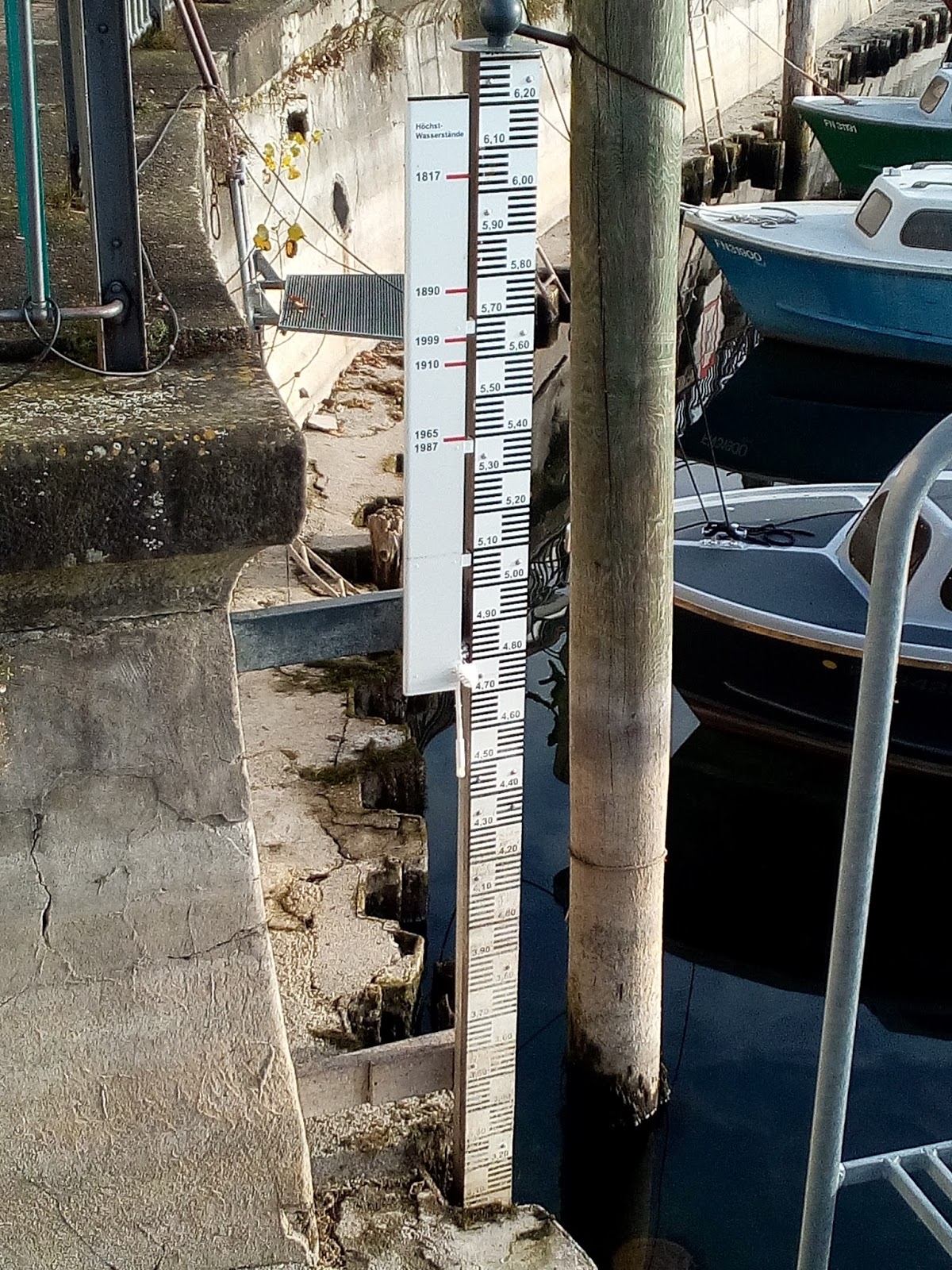
There are water gauges at strategic points around the shore. Langenargen harbour has one which runs from the current level (somewhere over 3 metres) to 7 metres, with the notable floods of the past marked on it near the top. These are impressive enough just to look at as a red line on a board above the current lake level: the highest recorded flood was in 1871, reaching 6.91m - this level also carefully marked on the adjacent tourist information office wall. Then try and grasp the sheer volume of additional water present in the lake to reach that height! Even if you ignore the fact that the lake shore is rather flat and just run a 'cylinder' vertically upwards, trying to fit 3 metres of water onto half of Dartmoor is somewhat hard to comprehend.

Some fag-packet calculations (assuming my arithmetic is robust). When the water level in the lake reached 3m above what it is today, that works out to about 1,713,000,000 cubic metres of water. Some 685,200 Olympic-size swimming pools. Put more simply still, that's an awful lot of water. A;though the whole lake catchment is large, the major input of water to the lake is the Rhine: the river must have been an awe-inspiring sight, particularly at the Rhine Falls just below the lake's exit. At this point the river drops some 20m; spectacular at the quietest of times.

There it is folks, in black and yellow

And just to add weight to the tourist information office walls.

Langenargen harbour this morning.
For a post-script: the lake froze over on a number of occasions, the most recent being in 1963, when at least one brave chap apparently rode a horse across the lake. Given that you're crossing a body of water which reaches some 250m depth... well. Where is the dividing line between bravery and foolhardiness, I wonder? I also wonder what the horse thought about it?

Sunday, 20 November 2016

Brexit - means Brexit.

OK, so it's a predictable title; sorry.

Here we are. We've left the sunny shores of south-west England and washed up on the banks of Europe's third-largest lake: Constance (Bodensee, as I'll probably end up referring to it forever after). We're living in a small village just to the north of the lake, just east of half-way along. Seek out the local town of Langenargen on your trusty online mapping programme and you'll get the general gist.

Moving here has been something of a mammoth task: quitting jobs in the UK was relatively simple. Making the house ready for the next family was somewhat more Herculean, but achievable. Packing for the move seemed to take forever and - despite being fairly thrifty with our posessions, an alarming amount of stuff, clutter, call it what you will, was shipped off to charity shops, friends and family.

The journey over was the next challenge: Dover-Calais ferry, or the tunnel? Or Harwich to Hook of Holland? We plumped for the latter, particularly because the long journey meant a proper break and a chance to sleep, as well as saving us the tedium of the Oostend-Brussels-Aachen stretch of motorway - anyone who's driven that route ought to understand. So, a ridiculously early start from Exeter, a fairly stress-free journey to Harwich and we board the ferry - strange to be looking back at the coast and think that this is not actually a holiday. A millpond crossing, glassily smooth, meant that we could watch seals loafing in the North Sea for a good long while - individuals asleep in the water, bottling happily a good hour's journey out to sea: looks like the life. If reincarnation could happen...

A short hop down the motorway and we were able to break the journey for a couple of nights with my in-laws: again, a stretch of the legs for the adults and a bit of rest from the tedium of sitting in a car seat for hours on end for two small children. Finally, the last stretch - past Frankfurt, Stuttgart and Ulm with barely a hitch - only to be held up for 20 minutes with an inexplicable traffic jam about a kilometre from our exit from the final motorway. Cruel. We rolled in, finally, to the driveway of our new temporary home and shoehorned ourselves and the children out of the car with a communal sigh of relief. Even the car seemed grateful to stop moving (ruthless anthropomorphism I know; sorry).

Since then, we've been gradually extending our knowledge of the area, getting to grips with a somewhat cooler winter climate than we've been used to, and dealing with what feels like a small Alp of bureaucracy - though to be totally fair, the general helpfulness of the average civil servant here is incredible.Registering ourselves, the car, working, finding future work, getting children settled in kindergartens, looking for a more permanent flat, finding health insurance, doctors, the local shops; the list feels endless, but somehow we're whittling away at it.

The local area if dominated by fruit growing. Lots of apples, in particular. Much of it is very intensive, as you would expect in a western European country, buy the as also some pockets of older traditional orchards, with big old trees and much more evident wildlife. Our local patch has such goodies as Grey-headed Woodpeckers, Hawfinch and a plethora of Tree Sparrows. Not bad when you're from Devon. Much, much more on the local area, walks and wildlife later though!

Looking forward to seeing what the rest of the winter - and then the spring may bring us...
The Saentis (in Switzerland) looms closest over the lake directly to the south. The snow which fell (on my birthday! There's a first!) has retreated up-slope considerably, but the mountain still looks nicely picturesque.

Looking south-east from the lake-front at Langenargen, the mountains in Vorarlberg (in Austria) a somewhat more forbidding presence. There's good birding to be had there...